Why does WHOIS say redacted for privacy, and can you still find the owner?
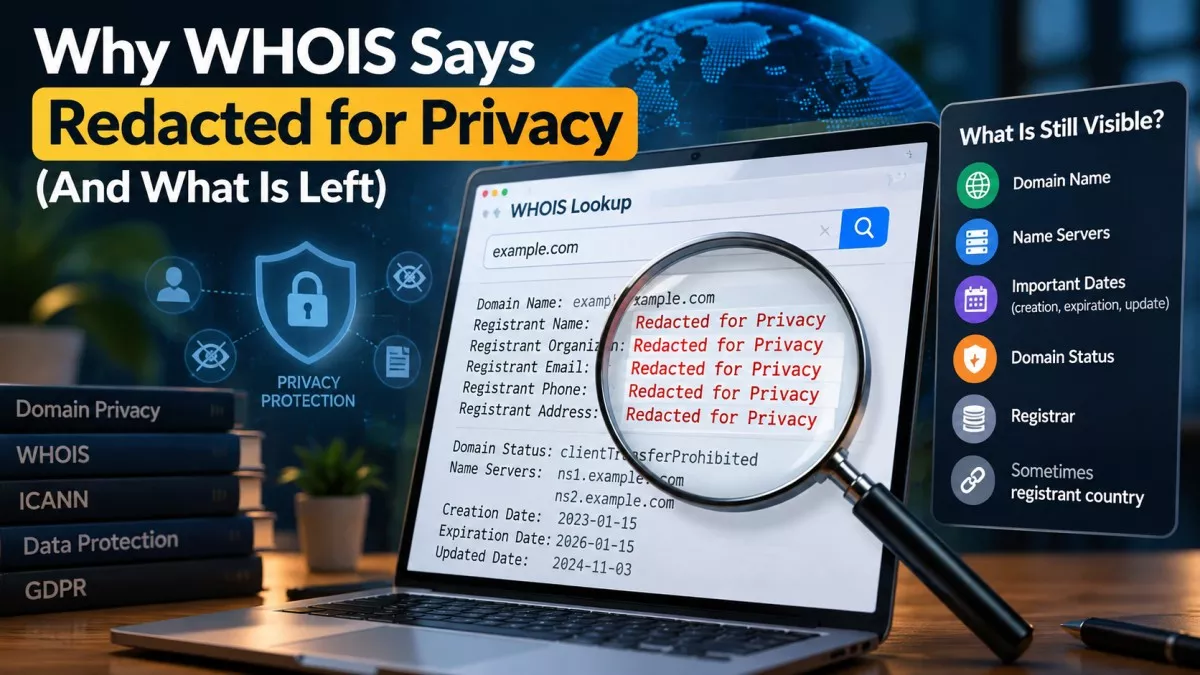
WHOIS says redacted for privacy because ICANN’s Registration Data Policy makes registrars strip the registrant’s name, street, city, postcode and phone number out of the public record. Nobody had to buy anything for that to happen. The registrar, the dates, the nameservers and the status codes are all still there.
You looked a domain up to find out who is behind it. Maybe it is a site republishing your posts, maybe it is a name you want to buy. Every field that would answer the question reads REDACTED FOR PRIVACY, and most of the advice you find suggests trying a different lookup tool. A different tool returns the same thing, because the redaction happens long before any tool sees the record.
Why does WHOIS say redacted for privacy on almost every domain?
Because redaction is the default for generic top-level domains, applied by policy rather than chosen by the owner. ICANN’s Registration Data Policy, in force since 21 August 2025, requires every accredited registrar and gTLD registry to redact the registrant’s name, street, city, postal code, phone and fax from public output unless that registrant has consented to publication. The admin and technical contacts get the same treatment.
None of this started in 2025. The scramble began in May 2018, when GDPR landed and ICANN issued a temporary specification that registrars implemented in a hurry and interpreted differently from one another. The 2025 policy is that emergency turned into settled rules. What changed for you is that the inconsistency is gone, so the fields are hidden on a Fortune 500 domain and on a hobby blog alike.
Does redacted mean the owner paid for privacy protection?
No, and that is the most common misreading of a modern record. REDACTED FOR PRIVACY appears on domains whose owners have never bought a privacy product, because the registrar has to remove those fields either way. Privacy services came first, and before 2018 they really were the only way to keep a home address off a public database.
What a paid service still does is stand in front of the details your registrar holds and forwards, and cover extensions ICANN’s policy does not reach. Whether that is worth a yearly fee is a fair question to argue about. Just do not buy it because you are picturing your address sitting in a public record, because on a generic domain it is no longer allowed to sit there.
Why does your usual WHOIS lookup now return nothing at all?
Because the WHOIS protocol itself has been switched off across generic domains. On 28 January 2025 ICANN removed the obligation for gTLD registrars and most registries to run a WHOIS service, and registries have been retiring theirs ever since. A tool still knocking on the old port 43 service gets silence rather than a record, and silence looks identical to a domain that does not exist.
RDAP is what replaced it. The Registration Data Access Protocol serves the same registration data over HTTPS as structured JSON, instead of the free-text paragraph WHOIS had been returning since 1982. Everybody still says WHOIS lookup. The lookups worth using are RDAP clients wearing the old name.
Why do two lookups on the same domain show different things?
Because a .com has two records and most tools read only the first. Verisign runs the .com registry and keeps what the industry calls a thin record: registrar, dates, status codes, nameservers, and a link across to the registrar’s own server. It carries no contact fields whatsoever, redacted or otherwise.
The registrar holds the full record, and that is where the redaction language lives. Follow the related link and the registrant object comes back with a remark titled REDACTED FOR PRIVACY, typed as object redacted due to authorization, and a name that reads REDACTED REGISTRANT. So “nothing at all” and “redacted for privacy” are often one domain answered by two different servers.
What can you still see on a redacted domain record?
Considerably more than the contact fields suggest. There are 7 things that stay public on a generic domain, and a few of them answer the question you were really asking:
- The registrar - Named, with the IANA number that identifies the company holding the registration.
- The abuse contact - An email address and a phone number every accredited registrar has to publish and has to monitor.
- Three dates - Registration, expiry and last changed. A last-changed date sitting on its own often marks a transfer or a nameserver switch.
- Status codes - Whether the name is locked against transfer, on hold, or moving through deletion.
- Nameservers - They name the DNS provider, and an unusual nameserver pair shared across several domains is one of the few ownership clues left.
- DNSSEC - Signed or unsigned.
- Organisation and country - Company registrations frequently keep both. Backlinko’s record currently answers REDACTED REGISTRANT for the name and Semrush Inc for the organisation.
The WHOIS Domain Lookup reads all of that straight from RDAP and puts it on one screen, with the raw JSON underneath for anyone who wants to check the record themselves. The contact rows will mostly show a dash. That is the policy working as designed, not the lookup failing.
How do you contact the owner of a domain that hides its details?
Through the web form or forwarding address the registrar is required to publish in place of the real email. The policy is explicit about it: where a registrar redacts the registrant email, it must publish an email address or a link to a web form that reaches that contact. On a redacted record it turns up as a contact URI pointing at the registrar’s own domain, and messages sent through it do arrive.
Finding the form means knowing the registrar first, and the Domain Registrar Checker returns that from the registry record in a single query. Nobody is obliged to reply, so expect plenty of silence.
Two other routes exist and both get misused. A registrar’s abuse address is for abuse, meaning phishing, malware and fraudulent use of a name, so a purchase enquiry sent there wastes everyone’s afternoon. ICANN’s Registration Data Request Service handles requests for the hidden data itself and has been extended to December 2027, but it was built for law enforcement, trademark enforcement and security research. A request with no legal basis behind it goes nowhere.
Can a paid WHOIS history service reveal the current owner?
It can show you what the record said before redaction, which is a different claim entirely. Domains registered before mid-2018 often have full contact details sitting in archived snapshots, and for an old name that never changed hands, that archive may well still describe the owner. A domain first registered in 2022 has nothing to archive.
Be sceptical of anything promising the current registrant of a redacted generic domain. What it sells is an old snapshot, or an inference assembled from shared nameservers and analytics identifiers, or the two blended together. An inference is not evidence, and it will not survive contact with a lawyer or a marketplace dispute.
Do country extensions like .uk and .de work the same way?
No. ICANN’s policy binds generic extensions such as .com, .org and .online, while country-code extensions are run by national registries that write their own rules. Nominet’s record for a .uk domain, to take one example, returns [email protected] in place of the registrant email.
Some national registries publish organisations and hide individuals. Others hand back little more than the nameservers and route every question through a legal request form. Read the registry’s own policy for the extension in front of you instead of assuming the generic rules carry over.
Does a redacted record affect your SEO?
It does not. Google has never listed registration data among its ranking signals, and now that redaction is the default across generic extensions, that data could not separate one site from another even if Google wanted it to. The same logic applies to domain age, which is not a ranking factor.
Where the record earns its keep is duller and more practical. Proving a name belongs to you, noticing that a domain you are about to buy is locked or close to expiry, working out who to write to about a site lifting your posts wholesale. None of that moves a ranking, and none of it needs the registrant’s name.
Final Thoughts
Look your own domain up before you decide anything about privacy products. The fields are probably blank already. And the record that proves the name is yours was never the public one anyway, it is the account at your registrar and the invoice attached to it.
Frequently Asked Questions
RDAP stands for Registration Data Access Protocol. It serves the same domain registration data WHOIS used to serve, but over HTTPS and as structured JSON, so a tool can read individual fields instead of parsing a paragraph of text. Since January 2025 it is the authoritative source for generic domains.
No. Redaction is applied by policy to nearly every generic domain, so it tells you nothing about the site behind it. Judge that on the content, the contact page, the payment provider and the history instead. A published registrant name is just as easy to fake as a hidden one is to hide.
Through your registrar account rather than the public record. Your registrar holds the full details and can produce them, and control is demonstrated by adding a DNS record or changing the nameservers. Google Search Console verification works that way too and never reads registration data at all.
Yes. The policy redacts those fields unless you consent to publication, so some registrars offer consent as a setting. Few owners take it, and spam is the reason: a published address gets scraped within days. Publish an organisation name and a role address if being reachable matters more.